By : Wael Magdy
Stuttgart and Bamberg, Germany – In the face of geopolitical tensions and trade barriers, the Bosch Group intends to exploit the growth prospects in its global markets with full innovative strength in the 2026 business year. The necessary upfront investments in areas of future importance are set to remain at the high level of previous years. In 2025 alone, Bosch devoted some 12 billion euros to investments in research and development and to capital expenditure. The supplier of technology and services is planning sales growth of 2–5 percent and an EBIT margin from operations of 4–6 percent for 2026.
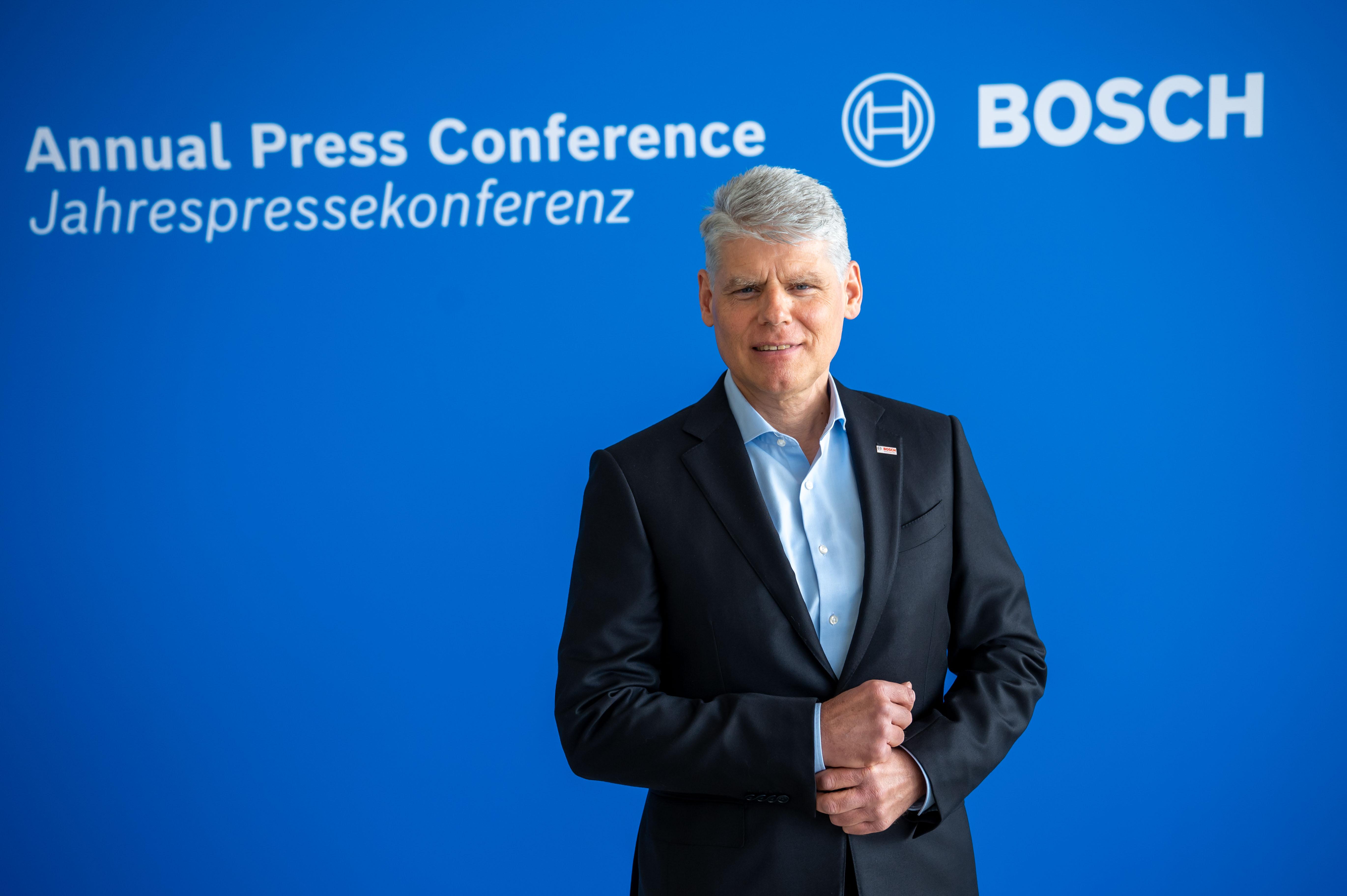
Referring to the presentation of the company’s annual figures, Stefan Hartung, chairman of the board of management of Robert Bosch GmbH, said: “As a global technology leader, we are committed to shaping the trends of automation, digitalization, electrification, and artificial intelligence, as this also paves the way for profitable growth in our business. An important prerequisite for this are the cost-cutting effects of the structural measures we have already initiated and innovations in all business areas.” When it comes to innovative strength, Bosch is one of the strongest industrial companies in the world and one of the most prolific patent applicants in Europe. Bosch registered around 6,300 patents in 2025 and was once again the leader in Germany.
Despite considerable challenges, Bosch was able to achieve sales revenue of 91.0 billion euros in the 2025 business year, slightly up on the previous year (2024: 90.3 billion euros). After adjusting for exchange-rate effects, this was equivalent to 4.1 percent growth. At 2 percent, the EBIT margin from operations was below the previous year’s figure (2024: 3.5 percent). Necessary structural and personnel adjustments to increase future viability had a considerable negative impact on result in the form of provisions of 2.7 billion euros.
innovation and differentiation to boost growth To achieve successful business development in an adverse global economic environment, the company must keep its costs at a competitive level. With the conclusion of talks with employee representatives on the necessary job cuts at all affected Mobility locations in Germany, Bosch is improving its future competitive position in the face of increasing price pressure. “The negotiations weren’t easy, but both sides demonstrated a marked sense of responsibility,” Hartung said. “We are now implementing the agreed measures as quickly and consistently as necessary, but also in as socially acceptable a manner as possible.”
In the automotive industry, China is currently setting the standard for price levels. Hartung therefore sees the expansion of innovation leadership as a key success factor for expanding business, particularly in the automotive market, and implementing the company’s Strategy 2030, which foresees Bosch being one of the three leading suppliers in its key markets. Trade barriers and different user expectations are currently both a challenge and an opportunity for regionally adapted solutions. “In international competition, it’s not just about costs, but above all about differentiating ourselves,” Hartung said, referring to Bosch’s global footprint, which he sees as a competitive advantage. “We can adapt our offerings and supply chains to regional conditions and at the same time deliver global-level quality.”
Business outlook 2026: generate financing for areas of future importance Bosch believes that the weak economic development of 2025 will continue in the current business year. High levels of uncertainty, primarily due to geopolitical developments with the as yet unpredictable effects of the war in the Middle East, are likely to continue to affect inflation and global economic output. Moreover, price and competitive pressure remains high.