- Capital.com and APCO publish the first white paper profiling one of the world’s fastest-growing retail trading hubs
- In the first half of 2025, MENA generated US$804.1 billion in trading volume on the Capital.com platform, including more than half a trillion dollars (US$576.5 billion) from the UAE alone.
By : Mohamed Essam
The Middle East and North Africa (MENA) region is rapidly establishing itself as one of the world’s most dynamic markets for retail trading of financial derivatives, according to a new groundbreaking white paper jointly published by global e-trading platform Capital.com and global advisory and advocacy firm APCO.
Drawing from Capital.com’s 25%[1] e-trading market share and two years of trading data from 62,850 verified MENA traders, who executed 85.5 million trades, the white paper, Trading’s New Horizon: How Access, Innovation and Ambition Are Fuelling MENA’s E-Trading Boom, shows that the surge is powered by a digitally fluent, ambitious population. According to the white paper, in the 18 months since Capital.com received its licence from the Emirates Securities and Commodities Authority (SCA) in April 2024, MENA, led by the United Arab Emirates, has become the company’s fastest-growing market and now accounts for more than half its global volumes.
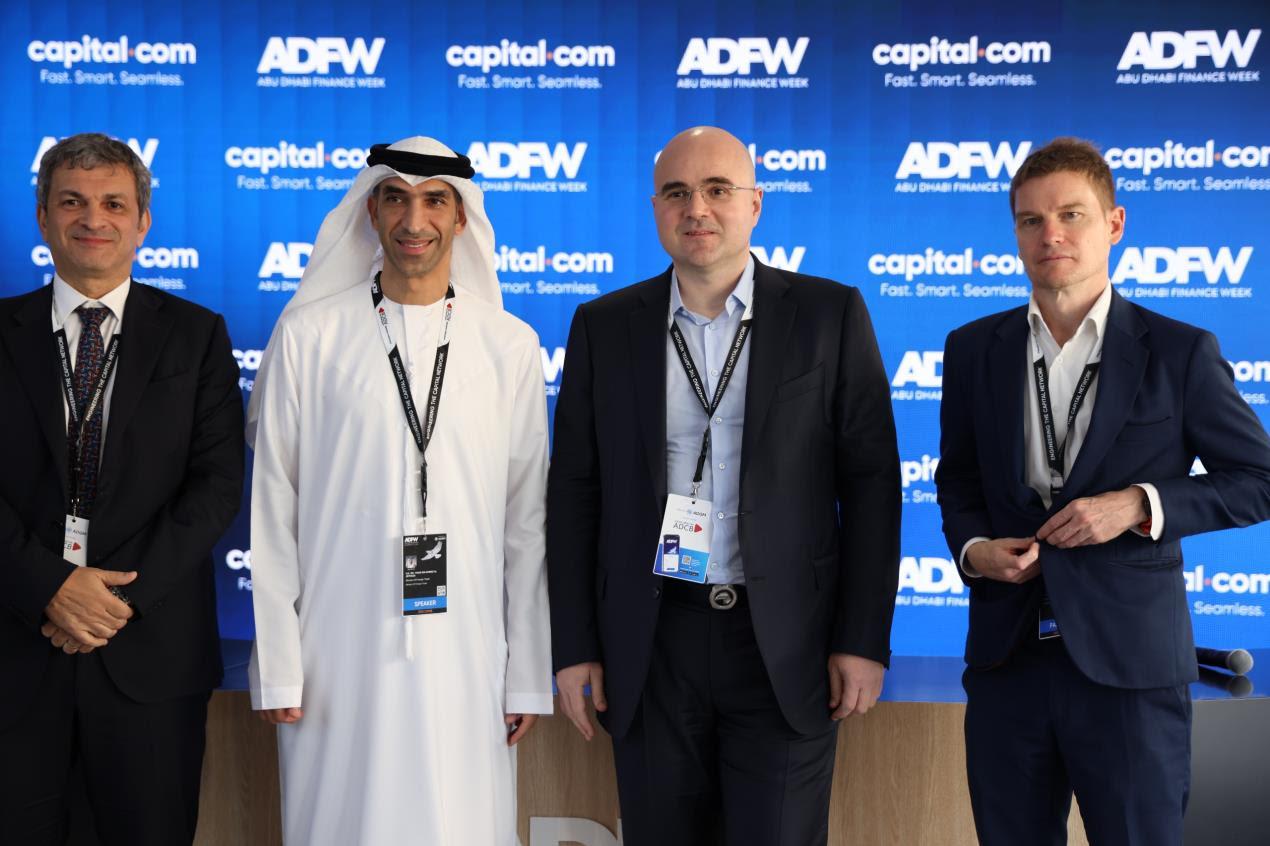
“The UAE’s strong performance highlighted in this white paper reflects the country’s commitment to building a competitive, future-ready digital economy,” said His Excellency Dr. Thani bin Ahmed Al Zeyoudi, UAE Minister of Foreign Trade, who gave opening remarks at the launch of the white paper on the sidelines of Abu Dhabi Finance Week (ADGW).
“By combining world-class infrastructure, forward-looking regulation and a growing culture of financial capability, we are enabling more people to engage confidently and responsibly in the opportunities of the modern global economy,” HE Al Zeyoudi added.
Capital.com’s trading volumes hit US$1.5 trillion in H1 2025, up 42.5% from H2 2024. Growth was driven by MENA, which reached US$804.1 billion (up 53.3%), with the UAE contributing US$576.5 billion (71.7%) of regional volume—strengthening its status as a fast-growing global capital for online, digital-first trading supported by Capital.com’s education-led approach. The white paper highlights that progressive regulation, high-speed connectivity, and near-universal mobile access have unlocked retail participation at scale.
“The Middle East is entering a defining moment in its financial evolution,” said Viktor Prokopenya, Founder of Capital.com. “Across the region, and particularly in the UAE, digital finance is unlocking unprecedented access to global markets, transforming how people trade, invest, and build wealth. This white paper captures that transformation in motion.”
Nearly 86% of the region’s traders are aged 18–44, and Millennials account for 55% of all active users. There are also more tertiary-educated MENA traders on the platform than their European peers (64% hold a university degree vs. 39% in Europe). MENA clients are also materially wealthier. Four times as many earn more than US$200k a year compared to Europe, and MENA recorded a 10x higher share of clients whose cumulative deposits exceeded $1M between May 2023 and May 2025, reflecting high disposable income as well as growing financial sophistication and ambition.
Learning-by-doing is a defining feature: nearly 45% of MENA traders begin with demo accounts, compared to 32% in Europe, highlighting a growing appetite for structured learning and financial literacy.
“The rise of e-trading in the Middle East illustrates how transparent regulation, progressive market access, and growing financial literacy are enabling individuals from varied backgrounds and levels of trading experience to participate in financial markets,” said Mamoon Sbeih, President of APCO MENA.
The research also reveals that MENA traders are highly active and embrace short-term trading strategies. They close 71% of their positions intraday (vs. 41% in Europe), and their most-traded assets include gold, oil, natural gas, major equity indices and crypto. However, despite closing more trades in profit – averaging 48.6% compared with 43.8% in Europe – only half as many MENA traders end up with positive net profits versus European traders. The gap is explained largely by limited use of risk-management tools.
“People here are always looking for opportunities to learn a new skill and, increasingly, financial markets are where they find it,” said Tarik Chebib, CEO of Capital.com MENA. “Part of what makes MENA and the UAE unique is the combination of capacity and ambition. But boldness, when unchecked, can easily tip into overconfidence. Risk management is one of the biggest gaps we see across the region and education plays a huge role in changing that behaviour.”
The study highlights the transformative role financial literacy can play in improving long-term outcomes. As the UAE intensifies its national focus on financial education, and as fintech platforms deploy AI-driven learning tools, the potential exists to turn MENA’s trading enthusiasm into sustainable, long-term financial empowerment. Recognising this key factor, the paper calls for increased emphasis on financial literacy and deployment by fintechs of AI-driven learning tools, enabling not only wider access to digital finance but also more responsible and sustainable participation.
“Trading has been both challenging and rewarding,” said a trading client of Capital.com MENA. “I’ve learned that discipline, risk management and flexibility are far more important than chasing big wins. My experience has shaped me into a more structured and strategic trader.”