By ؛ Islam Tawfik
Today’s printers are smart, connected endpoints, but in many SMBs they’re still managed like “set-and-forget” infrastructure and sit outside core security routines. In a distributed workplace, this creates an avoidable gap: printers handle sensitive information every day yet rarely receive the same controls as other managed devices.
Our latest research shows how print security has been deprioritized, with 57% of SMBs saying print security is a low priority in their cybersecurity strategy. The difference between how sensitive print workflows are and how lightly they are governed is the security blind spot many SMBs overlook, and one that attackers can exploit.
When print moves beyond the perimeter
Workflows that once stayed inside office environments now cross home networks, shared spaces, and personal devices that SMBs can’t easily see or control.
Print and scan workflows can carry payroll data, contracts, customer records, and patient information. If you can’t see who printed what, where, and when, you lose oversight of one of the simplest ways sensitive data can leak out. A single misdirected scan or uncollected print job can expose confidential information, often without any obvious sign that something is wrong.
According to Quocirca, 56% of SMBs have experienced a print-related data loss incident in the past year. A further 57% say documents printed on employee-owned home printers are now a top factor in data loss.
Our new research shows behavior is a key factor that increases this risk. 55% of SMBs say that employees try to bypass their organization’s print guidelines. Meanwhile, 66% of knowledge workers assume printers are secure simply because they sit behind a firewall, and half don’t consider printers a security threat at all.
Despite low prioritization, many SMBs acknowledge print security needs improvement and worry about the security risks outdated systems pose. The top printer security concerns reflect this tension:
- Cybersecurity risks linked to connected printers
- Confidential documents left on the printer
- Cloud vulnerabilities related to scanned documents
- Unauthorized access to print files or queues
- Misprinting, misfiling, or mishandling materials
Each of these risks are manageable, but only if SMBs treat print and scan workflows as part of the security perimeter.
Not doing so means resilience across hybrid workflows becomes guesswork. The Future of Work is not only about cloud and AI. It is also about securing the everyday document processes that move sensitive data across physical and digital environments.
Yesterday’s printers are a major security risk
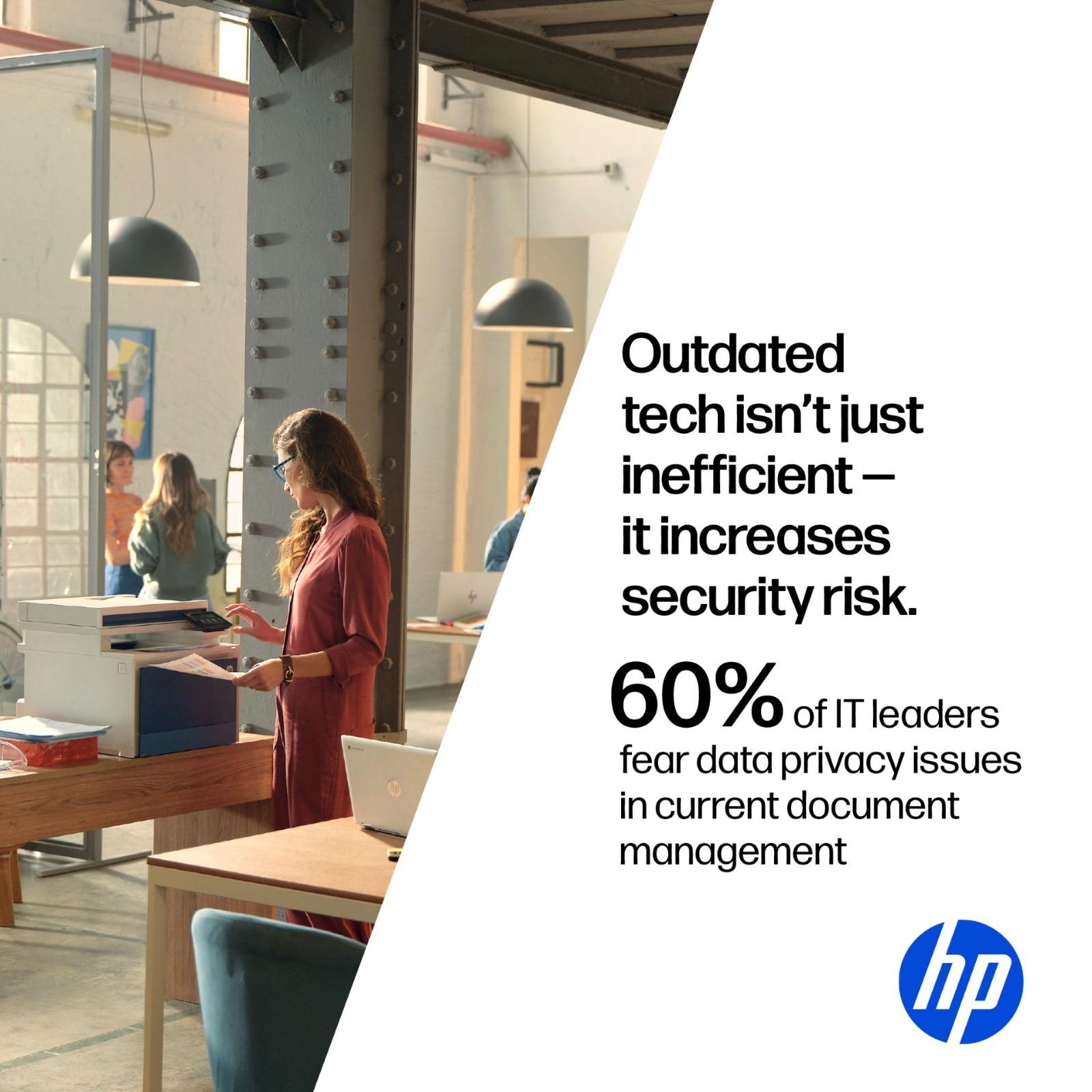
Another key risk is that almost two-thirds (65%) of SMBs frequently worry about the security risks outdated systems pose. SMBs still rely on older printers running outdated firmware and default credentials. These devices quietly process and store sensitive data while remaining largely unmanaged.
Outdated firmware and unchanged default credentials create entry points into the network. A compromised printer can provide a foothold into wider systems, particularly when it is not monitored with the same rigor as laptops or servers.
If laptops and servers require monitoring and controls, printers do too. Ignoring them leaves part of the attack surface unmanaged.
Smart printing makes control scalable
Almost seven-in-ten (69%) SMBs acknowledge print security needs improvement. To secure the future of work they need secure print hardware foundations and protection that keeps pace with evolving threats.
Smart printing builds on these secure hardware foundations by embedding visibility, policy enforcement, and audit trails directly into print and scan workflows.
Of SMBs that have adopted smart printing, 89% say it provides clearer visibility into printing and scanning activity across users and locations, 86% say it helps them meet compliance and security standards, and 85% say it improves enforcement of rules and restrictions.
In the Future of Work, printers cannot remain an afterthought. The financial impact of a data breach can run into the millions, alongside regulatory penalties and reputational damage. When print sits outside the security strategy, it creates avoidable risk.
Printers are not just office equipment. They are part of the digital infrastructure that supports modern work. As print and scan workflows become more digital and cloud-connected, printers deserve the same security attention as any other endpoint.
In practice, that means SMBs need three things: secure hardware as a foundation, security that keeps pace with new threats, and the visibility and control to maintain resilience at scale.
Bringing them into the security strategy is a practical step toward protecting sensitive data in a world where both work and risk are distributed.